What Is an Ambitus and Why You Will LOVE It!
by Don Chapman
After having a blast figuring out how to finally turn my Finale files into MuseScore files (and have an instant sheet music transposing feature to boot) I brainstormed with AI to see what other goodies I can come up with for Hymncharts and Worshiphymns.
The AI suggested a pitch range feature – what a fantastic idea!
Come to find out MuseScore has such a feature built in, called an “ambitus” so it was easy to add (which I did!)
As I love to point out, I’m old 😂 have a church music degree and have typeset my own music for the past 25 years and have never in my entire life heard the term “ambitus!” So I did a little research in to the origins of the term.
First, the Basics
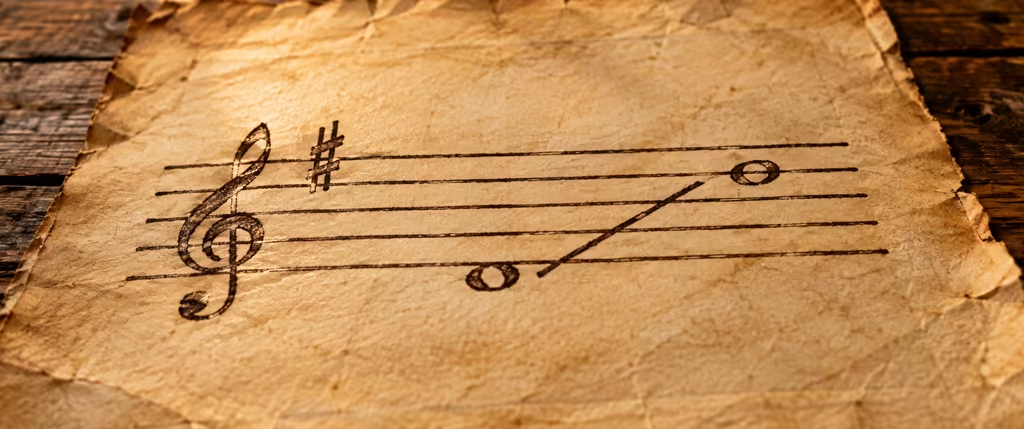
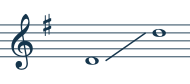
An ambitus is simply the lowest and highest notes of a song (or a single part), shown as two little noteheads stacked at the beginning of the staff. It’s pronounced AM-buh-tuhs, and the plural is… ambitus. (Latin keeps it simple once in a while.)
Those two notes are a summary. Nobody’s supposed to play them! One glance tells you whether a melody will work for your singers before you ever get to measure one.
It Started With Walking in Circles
Ambitus is Latin, from ambire, “to go around.” Roman writers like Cicero and Horace used it for things like a circuit, a boundary or the space around a building. It’s the same root as our English word “ambit,” as in someone’s sphere of influence.
In ancient Rome, ambitus ALSO meant bribing voters!
So how does a word about walking around a building end up in music? A melody roams around inside its own staff. It has boundaries.
Enter a Monk Named Guido
The earliest musical use I found comes from Guido of Arezzo, the Italian monk who invented “ut, re, mi, fa, sol, la,” the singing syllables that eventually became our do-re-mi. Around 1025 he wrote a music textbook called the Micrologus, and he uses the word to describe the path of a melody. He compares one phrase answering another to seeing your reflection in a well.
That’s a thousand years ago! Guido wasn’t drawing little range notes at the front of his staff, though. That came much later.
Every Mode Gets Its Own Neighborhood
In the Middle Ages, music was organized into church modes – mixolydian, phrygian, etc. Each mode had an assigned range, sort of a zoning ordinance for melodies. A 14th-century textbook called the Summula (its title mentions Guido, but somebody else wrote it about 300 years later) defines ambitus as the “proper space” each mode gets.
Theorists even called a mode’s range its domicilium. Its home. Melodies had home addresses!
The Overachievers
Johannes Tinctoris put together one of the very first music dictionaries (compiled before 1475 and printed around 1495 in Treviso, Italy). He sorted melodies into three categories:
- Perfect: the melody fills its whole range
- Imperfect: it doesn’t quite get there
- More-than-perfect: it goes past the boundary
So a melody that climbs too high was officially “more than perfect.”
Ambitus Learns English
By 1740 the word shows up in James Grassineau’s A Musical Dictionary, published in London. Want to see the complete entry? Here it is: “AMBITUS. See Modo.”
By the 1800s, German music dictionaries were using ambitus pretty much the way we do now, for the range of a melody, a voice or an instrument.
The Great Unsolved Mystery
So who first drew those two little notes at the beginning of the staff? I have no idea. As far as I could find, neither do the scholars. There’s no known inventor and no known date. Somewhere along the line an engraver or composer tried it, and it stuck.
Back to MuseScore
Today the ambitus lives on in notation software. MuseScore even has an “update to match notes on staff” button that figures out the range for you (which I’m implementing here at Hymncharts.)
For worship leaders, it’s a handy little tool. You can see at a glance if a song’s going to fit your congregation and worship leader, and pair it with the transposing feature to find a key that works in seconds. Just keep in mind two songs can share the exact same range while one of them stays up high for the whole chorus (that’s called tessitura, another fancy word I’ll save for another day).
I’ve gotten such a kick out of this, that if I ever finally have a kid I think I’ll name him or her “Arbitus Chapman!”
Bottom Line: Check the ambitus before you pick a key, and your congregation will thank you!

43 Million Streams