Why Hymncharts Piano Sheet Music Matches the Demo Note for Note
by Don Chapman
Have you ever purchased piano sheet music, sat down to play it and thought, “Wait a minute, this isn’t what I heard on the recording!” Maybe the sheet music gives you a generic piano accompaniment that sort of resembles the recording, but it certainly isn’t the part that caught your ear in the first place.
That’s one of the biggest differences between Hymncharts and many other worship sheet music websites:
What you hear in my demos is what you see in the piano sheet music!
Hymncharts Piano Sheet Music Matches the Demo Note for Note
I compose every Hymncharts piano part myself. Then I write out every note myself. I don’t create a recording and then hand it to somebody else to figure out.
With most published worship sheet music (or any sheet music for popular songs, for that matter), the person creating the printed piano part is not the person who created the original piano performance. A transcriber listens to the recording and does his or her best to translate it onto the printed page. Transcription is part hearing, part detective work.
That takes real skill, and I have tremendous respect for people who do it well. But it is still one musician interpreting what another musician played. Small details can easily change along the way.
At Hymncharts, I already know what was played because I’m the one who wrote it!
My Sheet Music Journey
Back in college I worked for a music publisher who had one of the earliest versions of Finale notation software, and I learned the ins and outs of professional engraving: where the stems should fall, how to space the measures, all those details that make sheet music easy to read.
When I eventually became a worship leader, the pastor handed me a copy of Finale 2000, and believe it or not, that’s the exact version I use to create my sheet music today. Yes, Finale is now officially defunct, but I plan on using it forever. A tech buddy of mine assures me that whenever a future version of Windows finally refuses to run Finale 2000, I can set up a virtual machine: a little “bubble universe” copy of Windows running inside my computer that WILL run it. Finale 2000 and I are in this for the long haul. 🙂
What Composer-Written Piano Parts Mean for Your Church Pianist
My research and 20+ years of doing this have surfaced benefits that go beyond simple accuracy:
1. Your pianist saves rehearsal time. Nothing burns up a Thursday night rehearsal like a chart that doesn’t match the recording. Instead of handing the poor pianist a vague chord chart and saying, “Just listen to the recording and figure it out,” you can give them the score and demo together. They can arrive at rehearsal knowing exactly what to play.
2. Volunteer pianists gain confidence. Most church pianists are faithful volunteers squeezing practice in between work, family and everything else. When they can trust that every note on the page is right, the second-guessing (and hours of trying to figure out the notes from a recording) melt away and they can simply play.
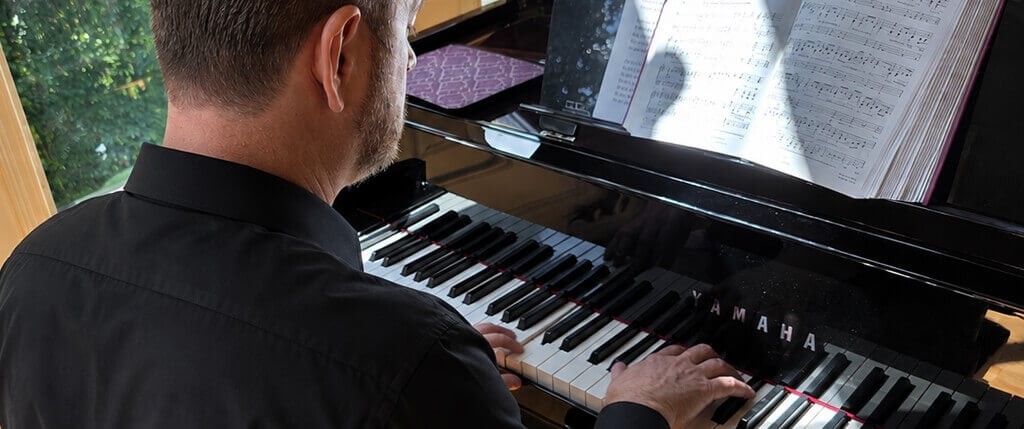
3. The parts fit under your hands. A piano part can look impressive on the page and still feel terrible under the hands. An arranger who does not play piano fluently might technically write the correct notes but spread them out in awkward ways, create odd leaps or use chord voicings no real pianist would naturally choose.
4. Practice by listening actually works. Many pianists learn best by ear plus page together. With Hymncharts, the demo IS the practice track, and what they hear reinforces what they read.
Bottom Line: At Hymncharts the composer and the engraver are the same guy, so the demo and the page always match.
43 Million Streams