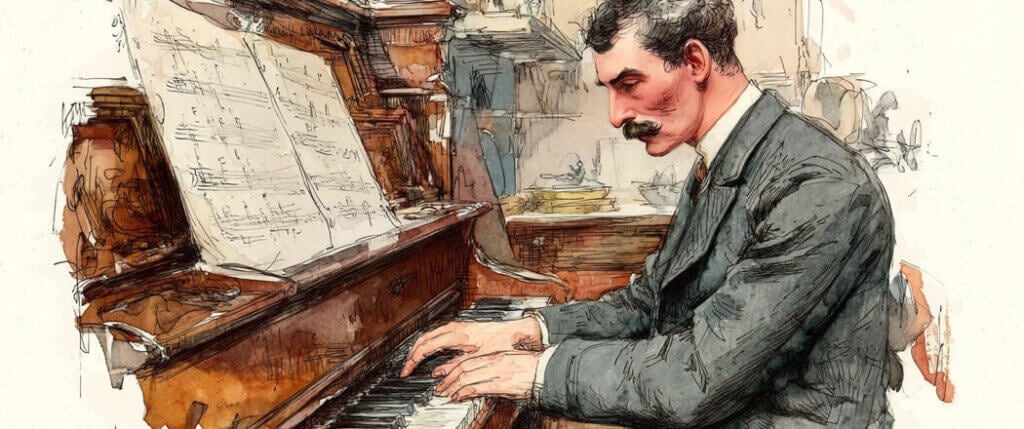
Charles Gabriel’s Songwriting Tips
by Don Chapman
I recently wrote a new melody to Charles Gabriel’s “My Savior’s Love” lyrics for my Hymns Reborn series. The new song is called “Marvelous (I Stand Amazed)” and you can download it for free here. As I researched Gabriel for a hymn history, I was intrigued to discover that he had written specifically about the craft of songwriting. How cool is that – and his wisdom applies wonderfully to today’s worship leaders.
Reading his principles, I realized something: I’ve been following many of them for years without knowing it. I take great care that a melody fits the words as naturally as possible, and that the chords and arrangement color the meaning of the text. Gabriel taught the same things over a hundred years ago.
Gabriel wasn’t just prolific, he was intentional.

Here’s what the man behind “His Eye Is on the Sparrow” can teach anyone writing for the church today.
1. Know what your song is about from line one.
Gabriel said a good gospel song should make its subject immediately clear (“an immediate declaration of subject”), then unfold that subject logically and intelligently. He had no patience for vague religious feeling. A song should know what it’s about from the first line.
What constitutes an acceptable and useful gospel song? First, the text must be systematically constructed, be spiritual and devotional; it should begin with an immediate declaration of subject, followed by an explication presented in a logical and intelligent manner.
Think about how many worship songs today could be about almost anything (the many generic wind, fire, etc. references.) Gabriel would tell you to pick your subject, state it early and develop it with purpose. Your congregation shouldn’t have to guess what they’re singing about.
2. Let the chorus carry the main thought.
Gabriel called the refrain the “crowning glory” of a gospel song. In his method, the main thought of the entire song belongs in the chorus. The verses build the case; the chorus delivers the message.
A subject presents itself, and, as it takes form in the mind a melody comes singing its way with the first stanza; the main thought is always in the chorus, which should become the crowning glory of the song.
This might be his most useful tip for modern writers. Don’t let your chorus merely repeat energy or pile up filler phrases. Let it crystallize the message so clearly that if someone only remembered the chorus, they’d still carry the whole point of the song home with them. Gabriel practiced what he preached: in “My Savior’s Love,” the refrain gathers the entire song into one unforgettable response: “How marvelous! How wonderful!”
3. Melody is ministry, not decoration.
For Gabriel, melody was indispensable. He said a gospel song simply would not succeed without a real melody, especially among children and young people, and that a more pleasing melody would usually accomplish more good.
He put this into practice. “Brighten the Corner Where You Are” was deliberately built on an attractive melody carrying practical Christian truth. Gabriel understood that the tune is what carries the words into someone’s heart and memory. A strong melody isn’t ornamentation. It’s part of the song’s spiritual DNA.
4. Write music to serve the words.
Gabriel strongly objected to what he saw as the factory method of songwriting: grinding out melodies first, then hiring lyric “tinkers” to fit words onto them (so many modern pop songs are constructed just like this!) He believed sacred music should interpret the text. As he put it in his later years, music is composed to interpret the theme of the words.
This is the principle I’ve followed most in my own writing. When I composed the new melody for Marvelous (I Stand Amazed), my goal was for the melody to feel like it grew out of Gabriel’s lyrics naturally, and for the chords and arrangement to color the meaning of every line. The text lead and the music serves.
5. Simple doesn’t mean shallow.
Gabriel spent much of his career defending the simple gospel song against critics who considered it beneath serious music (and doesn’t this sound like the worship wars of today, with traditionalists complaining that worship songs are shallow!) He loved the story of an evangelistic singer who was challenged about using such simple songs. The singer replied that he would gladly use a better class of song as soon as someone showed him something that touched human hearts more deeply.
Gabriel concluded that simplicity was the very power behind gospel song. His “O That Will Be Glory” proved it, spreading around the world and translated into many languages and dialects.
He never defended weak writing, though. He criticized childish Sunday-school songs as intellectually below the people singing them, and he expected sacred songs to keep improving in both text and music. His model was simplicity with dignity.
6. The congregation is the test, not the critics.
I love this one! Gabriel said the gospel singer sings not merely for “ears,” but for people carrying sorrows, anxieties and spiritual burdens. He spent more than twenty years traveling, teaching and observing what ordinary people could and would actually sing. His conclusion: community singers are like children in one sense. They sing what appeals to them, and they lose interest in what doesn’t.
To this experience I ascribe any degree of success I may have since attained, as it brought me into direct contact with the masses of uneducated singers and told me what they could and what they could not sing, what they liked and did not like. It taught me also that community singers are a great deal like children, in that they will sing spontaneously the song that appeals to them, but will not become interested in that which does not please them.
Here’s the modern version: if your church doesn’t catch on to the song, it doesn’t matter how impressive the demo sounds. Trained musicians are not the audience. The single mom in the third row is. The teenager who’s not sure he believes any of this yet is. Write for them.
7. Inspiration is real, but it arrives as raw material.
Gabriel believed inspiration came from God, but he rejected the idea that songs arrive as finished jewels. He compared inspiration to rough material the writer must work out, and he was openly skeptical whenever someone claimed a hymn had been dictated word for word by divine agency (and I am, too!) In his view, God gives the gift. The songwriter still has to labor over it.
Believe in inspiration, but do not believe the Great Master is dealing out cut and polished diamonds; he gives the thought, and the author must work it out.
His own experience proved both sides of this. When Civilla Martin sent him the text of “His Eye Is on the Sparrow,” Gabriel was despondent at the time, yet the melody came to him immediately, essentially in the form we still sing today. But he also admitted that some songs impressed him before the ink was dry while others he completely underestimated. Even Gabriel couldn’t always tell which songs would last. Interesting that the melodies are what can nearly instantly appear. This is exactly how I wrote Marvelous – the melody and chords flew out as I sat at my piano in one five minute sitting.
8. Live the song before you write it.
In his later years, Gabriel said the gospel songwriter must live his song. Sacred songs, unlike secular ballads, must come from the heart, and he warned plainly that writing with financial gain as the ruling motive would fail.
He also lamented how deeply commercialism had crept into sacred music publishing, and he criticized chorus “stunts” that served the song leader’s reputation more than the worshiping congregation. He wanted songs that serve worship, not songs that serve a brand.
Commercialism has entered into the writing and publishing of sacred music to a degree that is discouraging. Must the church, because of this, be obliged to go back into the past for its music, when the entire world of art, craft, science, and mechanics is advancing with such wonderful strides?
That warning was written a century before social media, worship influencers and streaming playlists. It has never been more relevant!
A hundred years later, same battles
What strikes me most about Gabriel is how familiar his battles feel. He fought commercialism, gimmicks, novelty for its own sake and songs written for image instead of worship. He fought them in 1915. The names have changed since then, but the temptations sure haven’t!
And his answer wasn’t to retreat into the past. Gabriel told younger writers that tomorrow would need its own songs, that those songs might sound different from his generation’s, but that they must carry a definite message and be crafted with real skill. He wanted the next generation to carry the purpose forward with better craft. What a visionary he was!
There will be a tomorrow, and that tomorrow will need songs. Some one must write them, why not you? The song of tomorrow may be different from ours, but it will be one of strength and appeal. It will carry a definite message, and be constructed in a musically and scholarly manner. Music of the people will improve at a more rapid pace in the future than it did in the past.
You today, have every advantage that could be made possible by wealth and opportunity, and upon you must fall the responsibility for the musical service of the church and community of tomorrow.
One more thing about Gabriel: he had an “inviolable rule” to write something every single day, and he described years of midnight labor behind his massive catalog. The man who insisted inspiration comes from God also worked harder at his craft than almost anyone in his field.
Try this week: Take a song you’re working on and run it through Gabriel’s filter. Is the subject clear from line one? Does the chorus carry the main idea? Does the melody serve the words? Could your congregation actually sing it and mean it?
Bottom Line: Write songs that serve the people singing them, let the music serve the message, and work at your craft every single day. That’s the Gabriel method, and it still works!
43 Million Streams