
Horatio Spafford

It Is Well with My Soul
Anderson University Choir sings this Hymncharts arrangement
| Words: | Horatio Spafford |
|---|---|
| Music: | Philip Bliss |
| Key: | Bb to C major |
| Time Sig: | 4/4 |
| Tempo: | 100 | ballad |
| Tune: | VILLE DU HAVRE |
| Meter: | 11.8.11.9. with refrain |
| CCLI #: | 5253184 |
| Verse: | Psalm 55:18 |
Sing this arrangement in your church! Download sheet music, chord charts, tracks and multitracks with a Hymncharts subscription.
Any Horatio Spafford biography eventually comes to an Atlantic deck in the dark. After the sinking of the Ville du Havre, Horatio crossed the ocean to meet his shattered wife, Anna. On that voyage, he later wrote of the place where the ship had gone down, yet refused to picture his daughters in the depths below. They were “safe, folded, the dear lambs.” That single line tells you much about the man behind It Is Well with My Soul. He did not deny pain. He tried, through tears, to see his children in the keeping of God.
The power of Horatio Spafford’s story is not simply that he suffered. Many people suffer. The power of his story is that sorrow did not drive him away from the Lord. It drove him toward Him. That is why this story still comforts the church. It is not merely the history of a hymn. It is the history of a wounded soul learning where true peace is found.
Before the Storm, a Man Already Walking with God
Before tragedy marked his name, Horatio Spafford was a successful Chicago lawyer, a Presbyterian church elder, and a devoted friend of Dwight L. Moody. He and Anna built a home in Lake View and raised their four daughters there. He taught Sunday School, helped lead prayer meetings, and moved in a circle of believers that included gospel musicians Ira Sankey and Philip Bliss. This matters because Horatio did not discover God only after disaster came. Faith was already the pattern of his life.
Their Christianity was active, not decorative. Horatio visited jails and prisons, supported revival work, and wrote hymn texts before his most famous hymn was ever known. Anna shared the same earnest spirit. Then, in 1871, the Great Chicago Fire devastated the city and destroyed much of Horatio’s real estate wealth. What had looked secure suddenly proved fragile. Yet even before the ocean tragedy, God was already loosening Horatio’s grip on earthly success and teaching him to hold tighter to things eternal.
“Saved Alone”
In 1873, hoping to give Anna rest and perhaps to connect with Moody’s work in Europe, Horatio arranged a family trip overseas. Last-minute business kept him in Chicago, so Anna and the girls sailed ahead on the Ville du Havre. In the early morning hours of November 22, the ship collided with the Loch Earn and went down in about twelve minutes. Annie, Maggie, Bessie, and little Tanetta were lost at sea. Anna survived and, after reaching Cardiff, sent back the short message that has echoed through history: “Saved alone.”
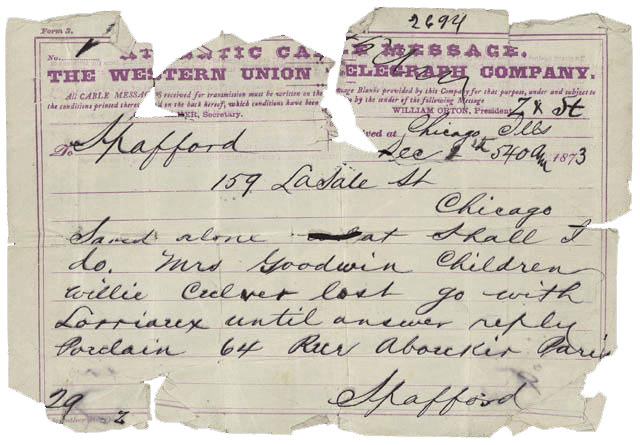
It is difficult to read that part of the story without going silent for a moment. Four daughters gone. A mother rescued from freezing water. A father left reading words that changed the whole course of his life. Yet even here, the Christian hope that later shaped It Is Well with My Soul had already begun to show itself. When Horatio crossed the Atlantic to join Anna, he wrote not as a man pretending loss did not hurt, but as a man trying to set his grief inside the larger mercy of God. There is something deeply instructive in that. Biblical peace is not numbness. It is trust in the middle of heartbreak.
The Hymn Was Forged in Grief, Not Written in a Flash
This is where the story grows even more interesting. Many retellings say Horatio wrote It Is Well with My Soul while passing over the very spot where his daughters died. One Library of Congress exhibition repeats that familiar version, and Library of Congress timeline material dates the lyrics to the 1870s soon after the shipwreck. Yet Ira Sankey later remembered something slower. Sankey said that when he stayed in the Spafford home in Chicago a few years later in 1876, Horatio wrote the hymn there in memory of his children. The hymn’s first singing, copyright, and publication all point to 1876. So the most careful conclusion is that the Atlantic crossing gave the hymn its grief, but the finished text may have taken shape later in Chicago. In many ways, that slower version is even more beautiful.
Why? Because it means the hymn was not a flash of feeling that vanished as quickly as it came. It was the fruit of grief carried to God over time. It was faith tested in the long days after the funeral silence, after the telegram, after the ocean crossing, after the first numb shock had passed. That is why the simple phrase “Whatever my lot” feels so steady. Philip Bliss later set Horatio’s words to music, named the tune VILLE DU HAVRE after the lost ship, and helped carry that private sorrow into the worship of the wider church through Gospel Hymns No. 2.
From Private Grief to Public Mercy
The Spaffords did not spend the rest of their days simply staring backward at the sea. A son, Horatio, was born in 1876, though he later died of scarlet fever in 1880. Daughters Bertha and Grace followed in 1879 and 1881. Around those same years, the Spaffords and a close circle of friends began meeting apart from their old congregation, emphasizing the mercy of God and a hopeful Christian life. Sorrow had not made them passive. It had pushed them to seek the Lord more deeply.
In 1881 they went to Jerusalem and helped form what became known as the American Colony. There, people were served regardless of religious background. Muslim, Jewish, and Christian neighbors all received help. That detail should not be treated as a side note. It belongs near the center of Horatio Spafford’s biography. The man who wrote one of the church’s great hymns of consolation also gave himself to a life of mercy. His peace was not a private feeling tucked safely away in a journal. It became service. Horatio died in Jerusalem in 1888, but the work begun by him and Anna outlived him by many years.
What Horatio Spafford Still Teaches Us Today
Most of us will never know the exact sorrows Horatio knew. But every believer eventually discovers that peace in Christ is not the same thing as an easy life. It is deeper than circumstance. It survives the fire, the telegram, the empty room, and the questions that linger long after tears begin. That is why Horatio Spafford still speaks so clearly. He reminds us that faith is not pretending all is well. Faith is learning, sometimes very slowly, that the Lord is still near, still good, and still worthy of trust when life hurts.
And that is the real story behind It Is Well with My Soul. The hymn did not have to be written in a single dramatic moment at sea to carry great power. In some ways, it carries more because it seems to have come through a longer obedience, a slower surrender, and a soul that kept returning to God. When our own storms rise, Horatio Spafford still points us in the right direction: not down into the darkness, but up to the Savior who keeps His children in life, in death, and beyond both.
A note from Hymncharts arranger Don Chapman:
For years I’ve enjoyed writing new music to classic hymn lyrics (which I call my Hymns Reborn series) but typically I don’t attempt to rewrite one of THE classics, like It Is Well with My Soul.
However, as I researched all the ins and outs and nooks and crannies of this epic story, I was so inspired that this new melody popped out of my head within only a few minutes. It’s truly my homage to the Spaffords, and a way to bring Horatio’s words to a modern worship setting.
If you’d like to sing this version in your own church, download free piano/vocal sheet music, chord chart and MP3 vocal demo below. Let me know if you’ve used it in your ministry! Learn more about It Is Well (Peace Like a River).
Download FREE lead / piano sheet music, chord chart, MP3 demo and lyrics text file. Permission granted to make as many copies as you need for your worship team. The login is in the Hymncharts newsletter – enter your email below to get it instantly (check your spam folder if you don’t see it).
It Is Well with My Soul Lyrics
When peace like a river attendeth my way
When sorrows like sea billows roll
Whatever my lot Thou has taught me to say
It is well it is well with my soul

It is well (it is well)
With my soul (with my soul)
It is well it is well with my soul

Though Satan should buffet though trials should come
Let this blest assurance control
That Christ has regarded my helpless estate
And hath shed His own blood for my soul

My sin O the bliss of this glorious thought
My sin not in part but the whole
Is nailed to the cross and I bear it no more
Praise the Lord praise the Lord O my soul

And Lord haste the day when my faith shall be sight
The clouds be rolled back as a scroll
The trump shall resound and the Lord shall descend
Even so it is well with my soul

Horatio G Spafford
Philip P Bliss
Quick Facts: Horatio Spafford
Horatio Gates Spafford (1828–1888) was a Chicago lawyer, Presbyterian elder, hymn writer, and Christian philanthropist best known for writing the text of “It Is Well with My Soul.” The hymn grew out of the 1873 sinking of the Ville du Havre, in which his four daughters died and his wife, Anna, survived, and it was first published in 1876 with music by Philip P. Bliss. Spafford later helped found the American Colony in Jerusalem, a Christian community known for charitable work among people of many faiths.

