
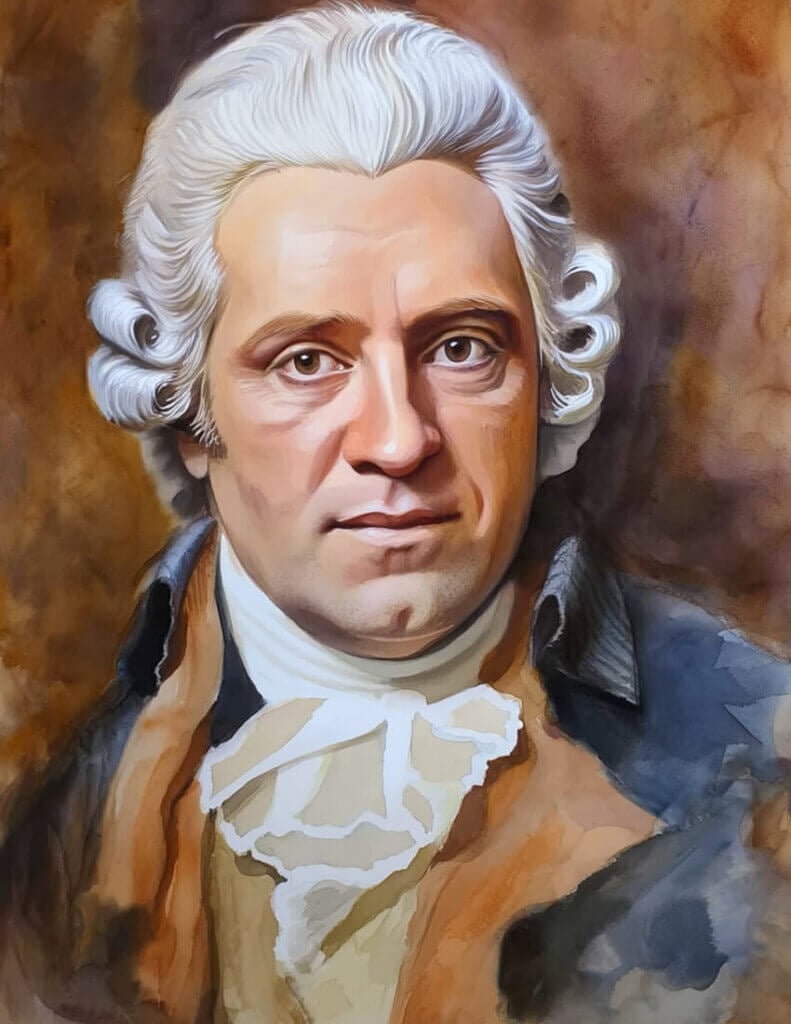
Edward Miller
When I Survey the Wondrous Cross
| Words: | Isaac Watts |
|---|---|
| Music: | Edward Miller |
| Key: | C major |
| Time Sig: | 3/4 |
| Tempo: | 106 | ballad |
| Tune: | ROCKINGHAM |
| Meter: | 8.8.8.8 |
| CCLI #: | 5205644 |
| Verse: | Galatians 6:14 |
Sing this arrangement in your church! Download sheet music, chord charts, tracks and multitracks with a Hymncharts subscription.
Somewhere around 1750, in the historic English city of Norwich, a teenage boy set down his paving tools and looked at the road before him. Edward Miller was the son of a pavior, a man who laid paving stones for a living, and everyone around him likely assumed his future was settled. He would lay stones as his father had done before him. But God had placed music in the boy’s hands, and the music would not be quiet.
The Runaway with a Calling
Edward did a bold thing. He ran away.
For a working-class teenager in eighteenth-century England, that was no small act. He had no money, no standing, and no guarantees. What he did have was a gift, and the Lord opened a door through that gift. Edward made his way to King’s Lynn, where he came under the instruction of Charles Burney. Burney saw promise in the runaway pavior’s son and trained him seriously in the craft of music.
That training carried Edward farther than he could have imagined. Through Burney’s connections, he was introduced to George Frideric Handel, and for a time served as a flautist in Handel’s orchestra. What a picture that is. A boy expected to spend his life kneeling over paving stones was suddenly standing among the musicians of the most celebrated composer in England.
By seventeen, Edward had already published his first work, Six Solos for the German Flute. God is not confined by the expectations placed upon a life. He knows how to take a person from obscurity to usefulness, and He often begins with a single act of courage.
A Long Obedience in Doncaster
In 1756, Edward was appointed organist of St. George’s Church in Doncaster. It was not London, nor was it the kind of appointment that draws great public notice. Still, it was the place the Lord had given him, and Edward stayed there for fifty-one years.
That may be the most striking thing about him.
The runaway boy became a remarkably steady man. He married Elizabeth Lee, made a home in Doncaster, and worked hard to support his family. His organist’s salary was modest, so he taught lessons, organized concerts, performed, and published music books. In time, Cambridge awarded him a doctorate in music, and the pavior’s son became Dr. Miller.
Yet his greatness was not found in titles. It was found in faithfulness. Too often, we imagine that God’s best work is done in large places, before impressive crowds. But the church has always been built in part by people who simply keep serving year after year in one town, one church, one calling. The Lord who led Edward out of Norwich also taught him how to stay.
Sorrow That Did Not Silence the Music
Edward’s life was marked by grief. In the first ten years of his marriage, Elizabeth bore ten children, and most did not survive childhood. Then Elizabeth herself died while still a young woman. Later came another crushing blow. His teenage son Thomas, serving aboard the East India Company ship Halsewell, was lost in the terrible wreck of 1786.
How does a man keep serving after so much burial?
Not by pretending the pain is small. Edward carried on through work, through worship, and through the steady habits of a life anchored in God. Many believers have discovered the same truth. When the heart is too bruised for grand speeches, simple faithfulness becomes a kind of prayer.
The Hymn He Never Heard
In 1790, Edward published The Psalms of David for the Use of Parish Churches. Within it was a tune he had adapted from an earlier melody. He reshaped it with care, gave it new strength and stateliness, and named it ROCKINGHAM in memory of his departed friend, the Marquess of Rockingham.
There is something wonderfully humble here. Edward did not pretend the melody appeared from nowhere. He took what had come before, worked on it with skill, and offered the result for the church’s use. Christian service is often like that. The Lord does not always ask us to create from nothing. Sometimes He asks us to steward, refine, and faithfully pass along what has been placed in our hands.
At the time, no one could have known what God would do with ROCKINGHAM. Edward published it as a tune for metrical psalms, then died in 1807 without ever hearing it paired with the words that would make it beloved across generations: Isaac Watts’s “When I Survey the Wondrous Cross.”
When I survey the wondrous cross
On which the Prince of glory died,
My richest gain I count but loss,
And pour contempt on all my pride.
There is something especially moving about that third line in connection with Edward Miller. “My richest gain I count but loss.” Edward knew what loss felt like. Yet the tune linked to his name now helps believers lift their eyes from personal sorrow to the greater sorrow, and greater triumph, of Calvary.
Fruit Beyond His Lifetime
Edward never got to see the full fruit of his labor. God did.
That may be the sweetest lesson in his story. The work God gives us is often smaller, slower, and less visible than we imagined. We may not see where it leads. We may not live to hear the choir at the far end of the story.
Edward could not have guessed that Christians across Britain and beyond would one day sing Watts’s great hymn to his tune. He simply did the work before him. He learned. He labored. He grieved. He stayed faithful. He offered the Lord his gifts, and the Lord carried those gifts farther than Edward could ever have planned.
Perhaps you are serving in a place that feels small. Perhaps grief has changed the shape of your days, and all you can do is continue in quiet obedience. Take heart from Edward Miller. The boy who fled paving stones did not spend his life chasing applause. He became something far better than famous. He became useful.
And the usefulness endured.
Every time believers sing “When I Survey the Wondrous Cross” to ROCKINGHAM, Edward’s melody still does its gentle work. It leads hearts toward Christ. It helps the church linger at the foot of the cross. It reminds us that God can take a life of hidden faithfulness and make it a blessing to generations yet unborn.
When I Survey the Wondrous Cross Lyrics
When I survey the wondrous cross
On which the Prince of glory died
My richest gain I count but loss
And pour contempt on all my pride

Forbid it Lord that I should boast
Save in the death of Christ my God
All the vain things that charm me most
I sacrifice them to His blood

See from His head His hands His feet
Sorrow and love flow mingled down
Did e'er such love and sorrow meet
Or thorns compose so rich a crown

Were the whole realm of nature mine
That were a present far too small
Love so amazing so divine
Demands my soul my life my all
Love so amazing so divine
Demands my soul my life my all

Isaac Watts
Edward Miller
Quick Facts: Edward Miller
Edward Miller (1735–1807) was a prominent English organist, composer, and historian best known for arranging the hymn tune ROCKINGHAM, the melody most commonly paired with Isaac Watts’ “When I Survey the Wondrous Cross” in the UK. A former flautist for George Frideric Handel, Miller served as the organist at St. George’s Church in Doncaster for 51 years. His most influential work, The Psalms of David for the Use of Parish Churches (1790), solidified his legacy in church music and hymnology.

